The traditional way of using IT AC DTIP for solving a task to find and then apply an efficient (optimal) tabular strategy of controlling some DTIP is as follows. At first, we study the discrete process itself and if it has the required set of properties, develop for it the appropriate informational, mathematical and software components, which are interconnected.
In most cases, a set of these components will be individual and purposed for a specific process. However, under certain conditions, there can be widely used universal software tools (USTs) designed to optimize DTIPs of certain classes and destinations. The term "universal" means here the ability to use a particular tool for solving many optimization tasks of this class without the need to its modification depending on the task to be solved.
As shown the experience of creation and exploitation of the USTs on optimizing DTIPs such software tools will be unclaimed in real life, if they are designed for abstract classes of discrete processes, rather than actual ones, encountered in practice. The attempt to create USTs for a wide class of DTIPs for many purposes also will not appear promising due to the high complexity and bulkiness of this problem.
In this regard, it is expedient to develop USTs focused on rather narrow subclasses of DTIPs of specific applications [6, p. 277]. Let us list some optimization tasks for discrete processes that can be successfully solved using such tools:
USTs for optimization of narrow classes of DTIPs can be widely used in practice, since the above-mentioned tasks are actual and are not always properly solved using designated for that the existing means. In order to USTs best suited for mass users, they should be developed in two variants: the usual (local) and the network. Local tools, having a relatively high cost, will be in demand by those consumers who will intensively exploit them. They primarily include commercial companies and government organizations, which regularly solve their own tasks.
Network USTs, which later on will be called network instrumental systems (in short — NISs), are designed for widespread use in the Internet. They are widely used in the following cases:
· when a user relatively rarely solves his optimization tasks (he will pay only the cost of their decisions according to current tariffs);
· when a user does not have a real opportunity to create his own database, describing the class of DTIPs that interest him (for example, if this database refers to a map of road network or to some set of income sources, offered for sale);
· when this tool is integrated into another one designed for mass users (Internet commerce, information terminals, etc.).
On the basis of NISs will be widely created the mass paid network services, which will be distributed in the Internet in two ways: either through the website of a future production company of implementing IT AC DTIP or through specialized commercial websites of a dealer network to provide such services. For their realization need to develop the next two system software products:
1) a template of a website for solving on commercial basis of the tasks to optimize DTIPs using this program toolkit;
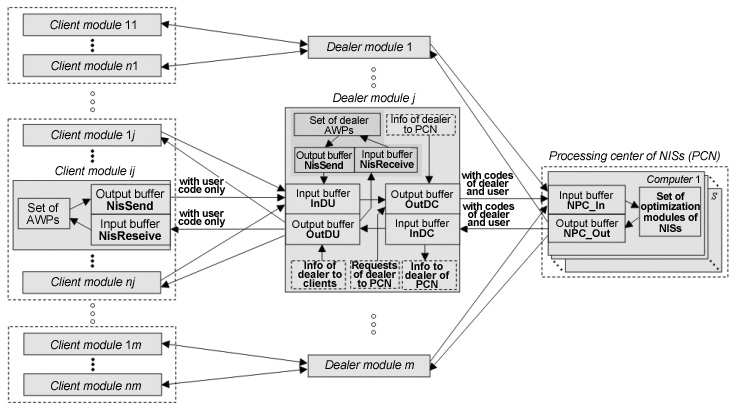
2) a program of automatic exchange of data and its protection for NISs, which can be used both in the dealer network of services, provided by NISs on optimizing DTIPs, and in a similar network of the future production company to implement Technology.
Fig. 1 shows an exemplary structural scheme of network communications in the dealer network of NISs.
Fig. 1. Structural scheme of network communications in the dealer network of NISs